Research
Research
04Passive reduction of unsteady lift fluctuations by sinusoidal trailing-edge waviness on a NACA 0012 aerofoil at low Reynolds number
First Author
Vortex shedding does not only affect mean aerodynamic performance: it also creates rapidly fluctuating aerodynamic forces that can contribute to vibration, fatigue and noise. In this project, I investigated whether deliberately introducing a three-dimensional wavy trailing edge could passively suppress these fluctuations without requiring an active control system.
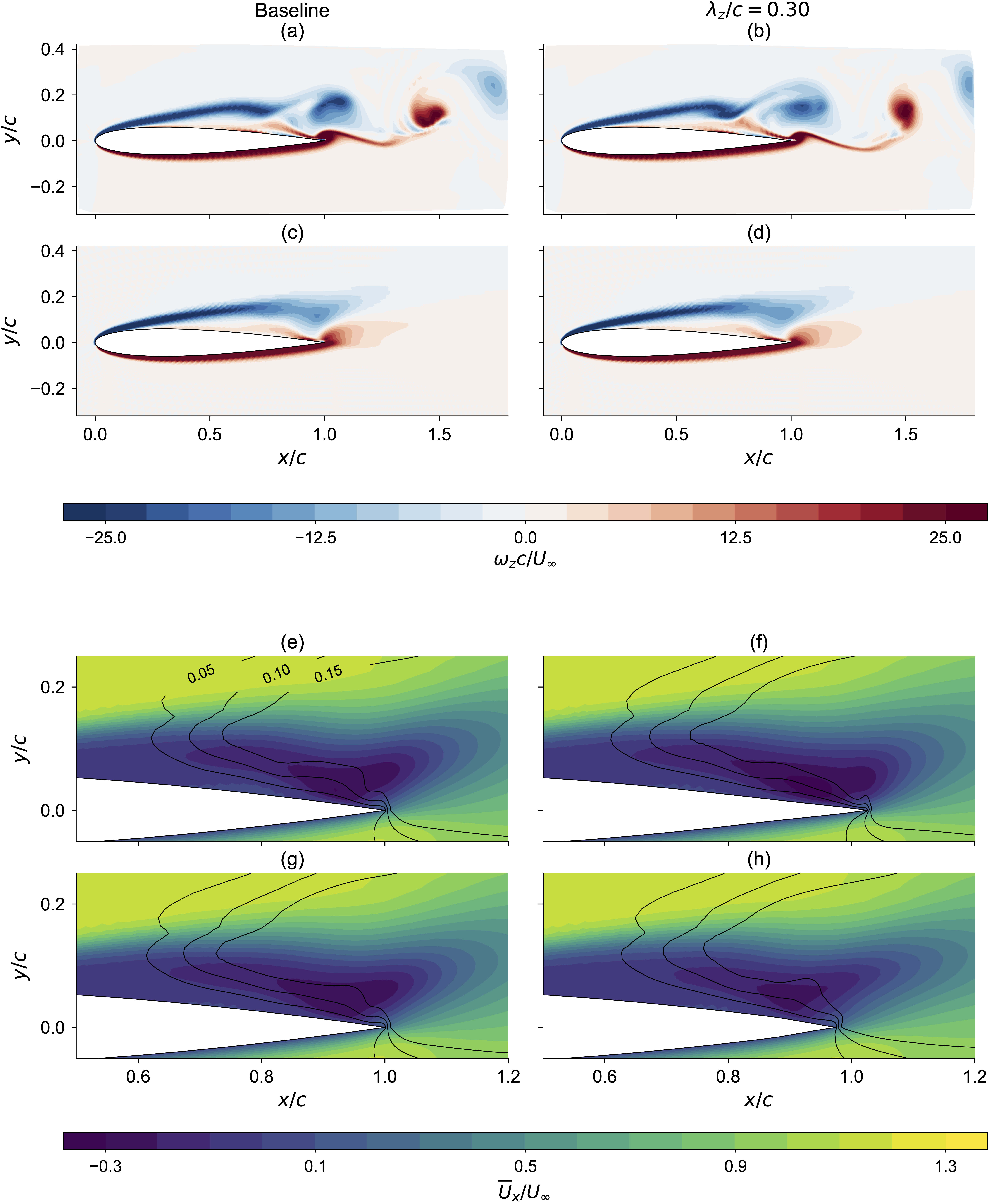
Using three-dimensional large-eddy simulations, I studied a NACA 0012 aerofoil at Re = 5,000 and an angle of attack of 9°. A straight trailing edge was compared with sinusoidal geometries of four wavelengths, λ/c = 0.15, 0.20, 0.30 and 0.60, allowing me to test whether the aerodynamic response depended on matching the imposed geometry to characteristic spanwise scales within the wake.
The response was strongly wavelength-dependent. The λ/c = 0.30 geometry reduced RMS lift fluctuations by 9.66%, with a 95% confidence interval of 2.98–15.46%, while producing essentially no change in the dominant shedding frequency and only a very small change in mean drag. It was the only tested wavelength for which the confidence interval of the lift-fluctuation reduction excluded zero.
I then decomposed the unsteady aerodynamic loading to investigate why the reduction occurred. The results indicated that the principal measurable mechanism was weaker local sectional loading rather than increased cancellation between different spanwise sections. This moved the project beyond simply showing that the geometry worked: it helped identify the physical mechanism through which a carefully selected three-dimensional geometry can suppress unsteady aerodynamic loading.
Under Review · Results in Engineering, Q1 · 9.4 Impact Factor
03Experimental Characterisation of Idealised Erosion Effects on the Static Thrust Performance of Propellers at Low Reynolds Numbers
First Author
My first erosion study showed computationally that very small geometric changes could produce unexpectedly large aerodynamic effects. I wanted to determine whether those effects would survive the transition from an idealised two-dimensional simulation to a physical, rotating propeller.
I designed the experiment from the ground up, including a three-bladed fixed-pitch propeller based on a triangular aerofoil and a purpose-built thrust-testing rig. The propellers were additively manufactured with controlled erosion to their leading edge, upper apex, or combinations of both. I then measured thrust and power across Reynolds numbers of approximately 20,000–40,000, while the updated study also incorporated validation of the thrust-measurement system and additional mixed-mode erosion data.
The experiments showed that erosion could either improve or degrade performance depending strongly on where it occurred, its magnitude and the operating Reynolds number. Leading-edge erosion was generally detrimental to propulsive efficiency, whereas removing material from the upper edge could reduce power consumption and improve performance under some conditions. Mixed erosion generally behaved as a combination of the individual modes rather than as an entirely separate response.
The study demonstrates why erosion cannot simply be represented by a universal performance penalty. For small UAVs operating in dusty terrestrial environments—or potentially on Mars—the same damaged propeller may perform very differently at different stages of its mission.
Under Review · Results in Engineering, Q1 · 9.4 Impact Factor

02Effects of Angular Rotation of Polygons on Vortex Shedding
First Author
When fluid flows around a bluff body, vortices periodically detach from alternating sides and produce oscillating forces. If this vortex-shedding frequency approaches a structure’s natural frequency, the resulting vibrations can become significant. I investigated how the geometry of polygonal structures affects both the frequency and variability of this shedding.
I created computational models of squares, hexagons and octagons at a Reynolds number of 200, testing each polygon at three angular orientations. My initial hypothesis was that increasing the number of sides would make vortex shedding less sensitive to orientation because the possible movement of the flow-separation point becomes progressively smaller.
The simulations supported this: from the square to the octagon, the range over which the separation point moved fell by 83%, while the standard deviation of shedding frequency across orientations decreased by 90%. However, the hexagon produced an unexpected result—the ordering of its maximum and minimum shedding frequencies was reversed relative to the square and octagon. Investigating this anomaly led me to propose an alternative way of classifying polygon orientation based on the geometry near flow separation rather than the conventional rotational labels.
The results are relevant to structures ranging from offshore pipelines to tall buildings, where designers need to understand the range of forcing frequencies that a structure may encounter as its geometry changes relative to the flow.
Published · Journal of Emerging Investigators
01A CFD Study on the Effects of Erosion on Aerodynamic Performance for a Triangular Aerofoil at Re = 10,000
First Author
Small aircraft and Martian aerial vehicles operate at low Reynolds numbers, where aerodynamic performance is particularly sensitive to changes in aerofoil geometry. Yet while erosion has been extensively studied for conventional aircraft and wind turbines, its effects on low-Reynolds-number aerofoils remain much less understood. I investigated whether relatively small amounts of erosion could significantly alter the performance of a triangular aerofoil designed for this flow regime.
I developed a two-dimensional computational fluid dynamics model of the aerofoil at a Reynolds number of 10,000 and simulated erosion at different locations and severities. Using lift, drag and surface-pressure distributions, I examined not only whether performance changed, but also how the location of the erosion altered the surrounding flow.
The results showed that aerodynamic performance was highly sensitive to where erosion occurred. Across the tested conditions, lift changed by between −35.2% and +23.2%, while drag changed by −16.0% to +28.8%. Leading- and top-edge modifications produced particularly strong changes to the suction-side pressure distribution, while top-edge erosion unexpectedly improved lift-to-drag ratio at positive angles of attack above approximately 2°.
Rather than showing erosion to be universally detrimental, the study demonstrated that small geometric changes can fundamentally reorganise low-Reynolds-number flow. This raised a broader question that motivated my later experimental work: would these computational trends persist on a real rotating propeller?
Published · Journal of Emerging Investigators
Research Themes
Detailed overviews of Harry Liuhan’s core theories, methods, and problem domains across disciplines.

Core research areas and methods
This section maps Harry Liuhan’s main lines of inquiry across physics, engineering, mathematics, and CFD, outlining the governing theories, numerical methods, and experimental frameworks that connect them, so you can quickly situate each project within its wider scientific context.




About
Grants, collaborations, and open questions
A living record of funding, collaborative networks, and emerging lines of inquiry, including speculative ideas, early-stage models, and unanswered questions that extend beyond individual projects yet shape the direction and ambition of Harry’s research programme.
 Harry Liuhan