10th May 2026
Imagine watching a mass bounce on a spring. If the mass and spring stiffness are known, predicting its motion is a familiar mechanics problem. Reverse the direction, though, and things become less straightforward: can a recording of the motion tell us both the mass and the stiffness?
For an ideal undamped oscillator, the angular frequency is the square root of stiffness divided by mass. That ratio is the problem. A one-kilogram mass on a spring with stiffness four newtons per metre oscillates at the same frequency as a two-kilogram mass on a spring with stiffness eight newtons per metre. Give them the same initial displacement and velocity, and their displacement histories match exactly.
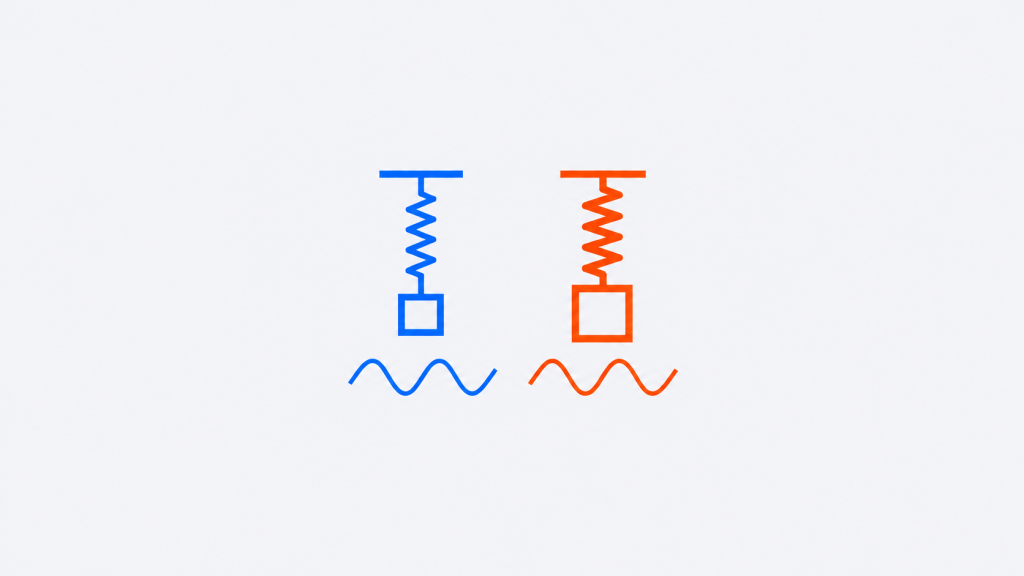
Recording for longer will not separate them. Nor will using a more accurate camera. The missing information is structural: the observation identifies a ratio, while the question asks for two individual quantities. Infinitely many pairs produce the same answer. An optimiser could return one pair with an excellent fit, but the quality of the fit would not make that pair uniquely correct.
A small change to the experiment helps. Add a known extra mass and measure the new frequency. The first measurement gives stiffness divided by the original mass. The second gives stiffness divided by the original mass plus the known addition. Together, the two relationships can determine both unknowns, provided the ideal model remains appropriate.
For example, an original angular frequency of two radians per second gives a stiffness-to-mass ratio of four. If adding one kilogram reduces the angular frequency to the square root of two, the new ratio is two. Solving the two relationships gives an original mass of one kilogram and a stiffness of four newtons per metre. We have changed what is observable by changing what we do.
Inverse problems also face a separate difficulty: small measurement errors can sometimes produce large changes in the inferred answer. Regularisation introduces additional restrictions or preferences to stabilise a reconstruction. Those assumptions can be useful, but they need to be visible; they are part of how the answer is selected.
The spring example makes me wary of treating agreement with data as the final test of a model. Before asking how accurately parameters can be fitted, I would ask whether this particular experiment can distinguish them at all. Sometimes the most useful improvement is neither more computing power nor more decimal places. It is a second measurement that asks the system a different question.
 Harry Liuhan
Leave a comment