10th August 2026
Suppose a modified wing produces smaller fluctuations in its total lift. The immediate explanation might be that the flow has become less unsteady. But there is another possibility: different parts of the wing remain active while their contributions cancel more effectively.
Imagine dividing the wing into two spanwise sections. Each produces a sinusoidal lift fluctuation of amplitude one. If both rise and fall together, the combined amplitude is two. If they are exactly half a cycle apart, their sum is zero. Nothing has changed about either section’s individual fluctuation amplitude. Only their timing has changed.
For sections with equal root-mean-square fluctuation σ and correlation ρ, the variance of their combined fluctuation is: Variance(Lift_1 + Lift_2) = 2σ^2 (1 + ρ)
With perfect positive correlation, the combined root-mean-square value is twice σ. With zero correlation, it is the square root of two times σ. With perfect negative correlation, it vanishes. The formula explains why adding local fluctuation strengths alone is insufficient: their relationships contribute to the total.
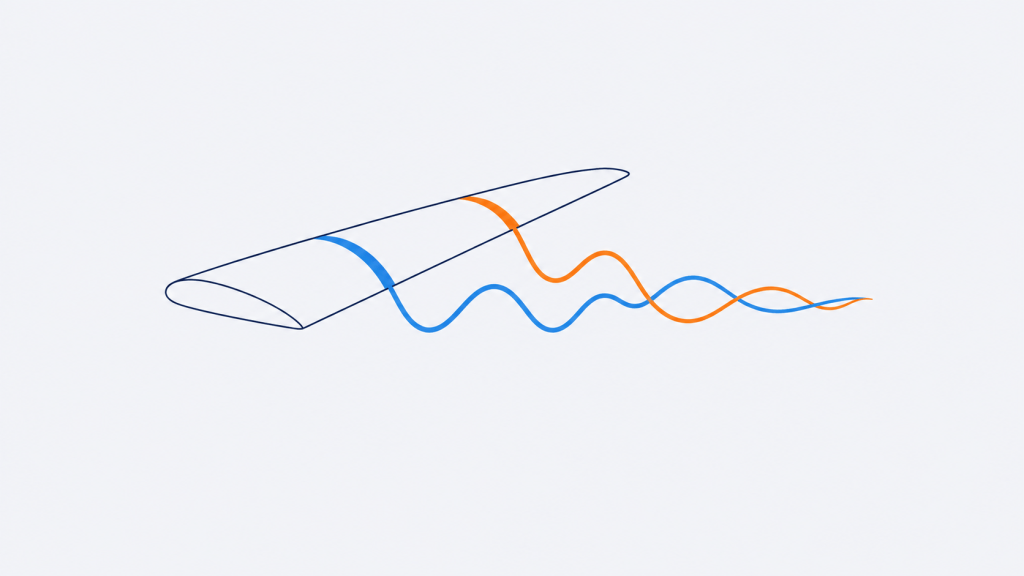
This distinction matters when interpreting aerodynamic flow control. Changing a trailing edge can alter local fluctuations and their organisation across the span. Research on bluff-body wakes and flatback airfoils considers spanwise correlation because it helps connect the wake’s spatial structure to its fluctuating forces. [1]
For a hypothetical comparison between straight and wavy trailing edges, I would want several views of the same data. First, the mean total lift and its fluctuations. Second, the fluctuation strength of each section. Third, the covariance between sections. If the total fluctuation falls while local values remain similar, changes in their relationships become an obvious place to investigate.
There is a useful subtlety here. A fixed phase difference between two perfectly periodic signals can produce cancellation even though their coherence at that frequency remains perfect. A smaller combined force therefore does not, by itself, establish that the signals have become incoherent. Stable phase offsets and genuinely changing phase relationships deserve separate checks.
I would also be cautious about probe position. If one probe sits farther downstream from a wavy edge than another, convection can introduce a time delay. Part of an apparent phase difference could come from the measurement geometry. Surface-force measurements and carefully matched wake probes would help test that explanation.
This is an appealing use of applied maths because a short variance identity changes the physical investigation. The question becomes more precise: has the design reduced individual contributions, altered their timing, or done both? A smaller total number is the starting observation. Explaining how that number became smaller requires looking inside the sum.
[1] Papadakis and Manolesos — The flow past a flatback airfoil with flow control devices
 Harry Liuhan
Leave a comment